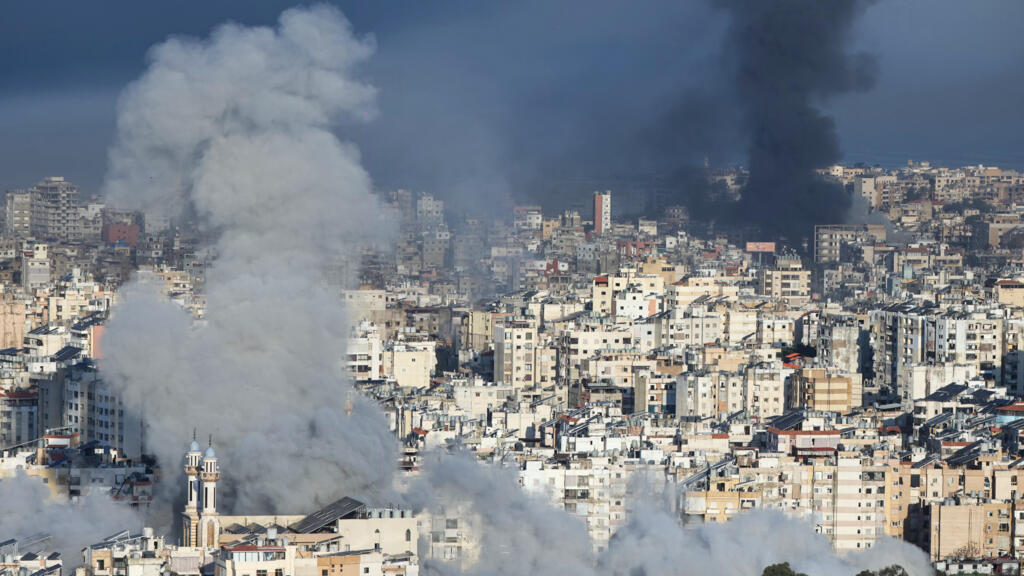
Smoke rises over Beirut’s southern suburbs after Israeli airstrikes as the Middle East conflict expands across the region.
Fresh airstrikes hit Iran and Lebanon on Friday as Israel signalled a new phase in the escalating Middle East conflict that has already spread across several countries and disrupted global markets.
Heavy overnight bombardments targeted the southern suburbs of Beirut, leaving buildings destroyed and vehicles burned. Thousands of residents fled the area amid fears of further attacks.
The conflict, now entering its seventh day, has drawn in global powers and intensified instability across the region, with energy markets and international transport routes also affected.
Explosions Rock Tehran
Powerful explosions were reported early Friday in Tehran, the capital of Iran, as Israel said it was targeting what it described as “regime infrastructure”.
Internet access across Iran has dropped to around one percent, according to monitoring group NetBlocks, making it difficult to assess the full impact of the attacks on civilians.
Residents reported unusually empty streets in Tehran, while security forces linked to the Islamic Revolutionary Guard Corps (IRGC) reportedly deployed armed personnel across major roads.
Israel Signals Next Phase of War
Israel’s military chief Eyal Zamir said the Israeli military was entering a new stage of its operations.
“We are now moving to the next phase of the operation,” Zamir said in a televised statement, adding that more actions were planned.
The escalation follows the initial wave of attacks launched last weekend which reportedly killed Iran’s Supreme Leader Ali Khamenei.
The United States has also signalled stronger involvement. Defence Secretary Pete Hegseth said American firepower over Iran could increase significantly.
US President Donald Trump ruled out immediate deployment of ground troops but said Washington would play a role in shaping Iran’s political future.
Rising Death Toll
Iran’s health ministry said at least 926 people have been killed by Israeli and US strikes, though the figures could not be independently verified.
Iran has retaliated with missile and drone attacks on Israel and several Gulf states.
At least 10 people have been killed in Israel, while the US military reported the deaths of six American personnel since the fighting began.
Lebanon Front Opens
The conflict expanded into Lebanon after the Iran-backed militant group Hezbollah launched missiles in support of Tehran.
Israeli strikes targeted multiple towns in southern Lebanon overnight, including densely populated districts in Beirut’s southern suburbs — an area considered a Hezbollah stronghold.
Lebanon’s health ministry reported at least 123 deaths following the attacks.
Scenes of panic unfolded as residents rushed to flee after evacuation warnings from Israel’s military.
Hundreds of displaced families gathered along Ramlet al-Baida Beach in Beirut with no clear shelter.
War Spreads Across the Region
The widening conflict has also reached parts of the Gulf region.
Qatar said it intercepted a drone targeting a US military base, while Saudi Arabia shot down three drones near Riyadh.
At least 13 people have been killed across Gulf countries since the war began, including an 11-year-old girl in Kuwait.
The conflict has even affected distant regions, including the Sri Lanka coast, where a US submarine reportedly destroyed an Iranian naval vessel.
Global Economic Impact
The escalating conflict is also shaking global markets.
Oil prices have surged by nearly 20 percent within a week as shipping traffic declines in the strategic Strait of Hormuz, a critical route for global energy supplies.
Market analysts warn that continued escalation could further destabilise global trade and financial markets.
About The Author